

Background.
For our final case study in the Biodesign Fundamentals class, we developed a conceptual solution for wound care patients, following all the steps of the Biodesign process.
CASE STUDY PROMPT
"Healthcare access and quality is a key social determinant of health. COVID-19 accelerated the development of telemedicine, such as remote patient monitoring. As we enter the post-pandemic world, how can technology be leveraged and advanced to move patients from the clinical environment to the home environment and address continued challenges in healthcare access, education, and staffing shortages?"

Stages of the Stanford Biodesign process
Preliminary Wound Care Research
50%
increased risk of major amputations for rural Americans with diabetic foot ulcers (DFUs)[1]
28%
patient mortality for individuals with chronic wounds over a 2-year period [3]
3%
of individuals aged 65+ have open wounds [2]
2-4%
allocated to wound care in Western health budgets [4]
PHASE I.
Needs Finding
Through our stakeholder interviews,
we gleaned the following info
about our patient population
preferences.
Informed, actively collaborating patients become emancipated, able to assume responsibility for their care
-Corbett and Ennis [Adv in Wound Care]
01
Empowerment
Users want to feel empowered to take care of themselves better by having more information about their conditions readily available.
02
Shared Decision Making
Users want to have a more active role and make informed decisions with their providers.
03
Personalized Medicine
Users want treatments to be more personalized and tailored to their individual needs.
Through our research and interviews, we built a diagram showing a patient's journey through the cycle of care.
CYCLE OF CARE
.png)
Our preliminary research helped us determine several areas of wound care that needed to be addressed...
PHASE II.
Needs Screening
PRELIMINARY SCREENING

-
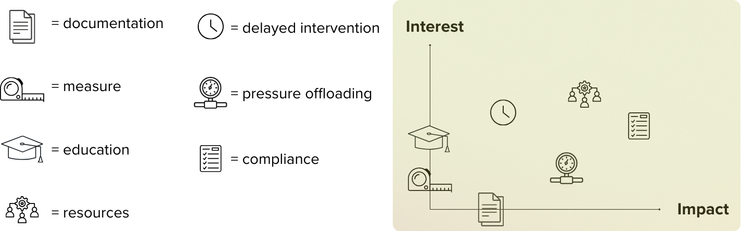
We organized the identified needs into topic areas and ranked them individually
-
We defined interest as our personal preferences and impact as a mix of how many individuals would be affected and the degree to which they would be affected by the problem being solved.
-
We then created a graph to visually prioritize the statements that the team was most interested in addressing, as well as those that showed the greatest potential for impact.
SECONDARY SCREENING
EXISTING TECH
-
WoundDesk
-
Swift Wound Care
-
Wound Rounds
-
Wound Vision
-
WoundWise IQ
-
Cares4Wounds
-
KroniKare
SHORTCOMINGS
-
Accuracy
-
Cost
-
Image segmentation must be done manually
-
Apps designed for clinicians rather than patients
-
Requires external attachments
-
We completed an initial technology assessment of current mobile wound care apps and found several shortcomings.
-
Through this analysis, we determined the gaps in the market and the needs that were not being addressed by current solutions.
-
This helped us narrow down our focus to the following problem statement that captured the key factors we wanted to address:
A WAY TO INCREASE COMPLIANCE, ACCESS, AND EMPOWER PATIENTS TO IMPROVE WOUND CARE OUTCOMES
PHASE III.
Concept Generation
We had several team ideation sessions where we created a variety of concepts.


PHASE IV.
Concept Screening
We evaluated our concepts against our defined needs and criteria, selected the most promising ideas, and filtered out less viable options.
WIREFRAMES


HI-FI PROTOTYPES
_edited.png)
CUSTOMIZED UI/UX

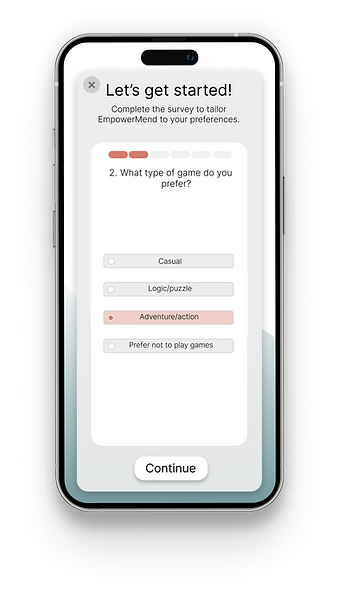

EmpowerMend provides a customized user experience tailored to each individual's needs. Users complete a personal preferences survey before using the app that takes into account their educational preferences and personal motivation. Our goal is to increase patient compliance as much as possible by meeting each patient exactly where they are and providing them with what will work best for them.
WOUND ASSESSMENT

Daily notifications to upload photos
Patients will be notified daily to upload pictures of their wounds, which are sent to the provider.


Detected wound sent
to provider
Actionable steps sent to patient
The patient will then receive a wound assessment summary from their provider which will provide clear insights on their wound and infection status, and actionable steps to be added to their goals list.
HEALING TIMELINE

The healing timeline provides AI-generated images of the patient's wound in the future at different stages of the healing process to allow easy tracking and a way to predict what to expect next. Recommendations from the provider are displayed along the timeline so the patient can keep track of each step they need to take.
GAMIFICATION


Customized education modules
Extrinsic Motivation
EmpowerMend uses gamification and personalized modules to boost engagement. The app tailors a “for you” experience based on the intro survey and activity patterns, offering materials that range from quick info bites to deeper academic content, plus active and passive exercises. Physicians can assign required modules, and a point system provides incentives for completing activities and logging wound updates. By adding fun and extrinsic motivation, EmpowerMend supports continued participation, especially for less engaged patients.

COMMUNITY SUPPORT
Patients can also join discussion boards and a broader wound care community. This space lets them connect with others, share questions, and exchange support. These peer interactions reinforce motivation and help patients stay engaged in their own care.
PROVIDER VIEW

EmpowerMend analyzes and annotates patient wound images, questions, and concerns, then compiles them into an organized report for providers. This creates a clean data source with wound labels, measurements, and progress indicators while saving clinicians significant time. Providers can review a wound-image timeline, monitor adherence to care goals, and stay connected to patients who face distance or access challenges.
SYSTEM ARCHITECTURE

A database of common wound care conditions and therapies with detailed descriptions was augmented using a large language model (LLM) trained to generate logical statements in question, rationale, and answer format. We used this dataset to train an open-source LLM5, which can be run locally, allowing protection of private data. We implemented a Retrieval Augmented Generation (RAG)6 pipeline to answer patient queries.
PHASE V.
Strategy Development
COMPARATIVE ANALYSIS

Most existing products focus on basic wound measurement and documentation, but EmpowerMend offers several novel capabilities that differentiate it. We have not identified any patents covering our approach to using AI for personalized app experiences, directing patients to the right resources, or generating a visual healing timeline.
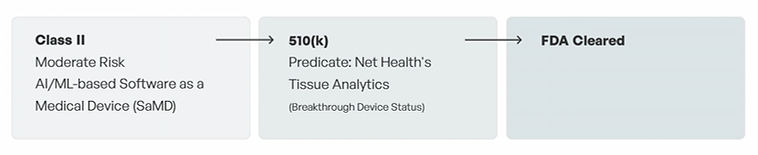
REGULATORY PATHWAY
Intended Use:
-
Assess wound and infection status
-
Generate a personalized healing timeline
-
Provide tailored educational content
-
Summarize care reports
-
Healthcare provider decision support tool
Indications for Use:
-
Patients at home and healthcare professionals in various settings.
-
Non-invasive, ensuring adaptable deployment across diverse healthcare scenarios.
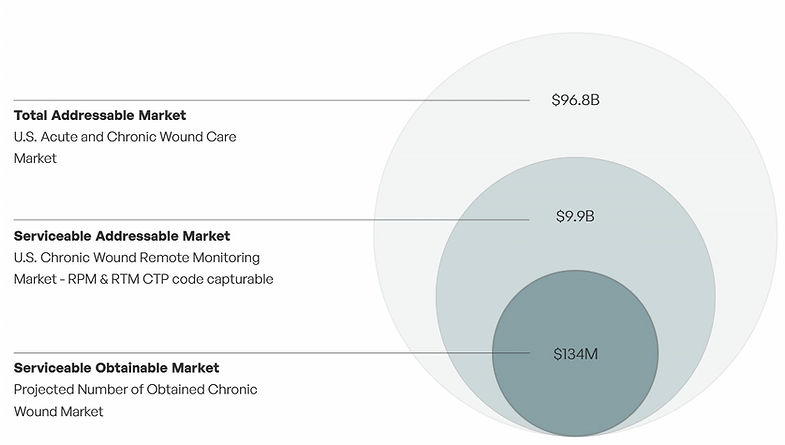
MARKET LANDSCAPE

BUSINESS PLAN
Value Proposition
Our value proposition centers on increased earnings through better capture of remote monitoring CPT codes and cost savings from preventative care that reduces complications. By improving operational efficiency, EmpowerMend allows clinics to manage the same volume of wound care patients with fewer human resources.
Business Model
Our B2B model targets hospitals, private practice groups, ACOs, and employers with in-house healthcare providers.


